
Bridging Conservation and Culture with Dr Jessica Bell Rizzolo: Reimagining Agency, Ethics, and Innovation for Wildlife Welfare - Part One

Updated: May 9
Camoya Evans interviews Dr Jessica Bell Rizzolo, an interdisciplinary researcher who focuses on wildlife tourism, wildlife trade (legal and illegal), and Traditional Chinese Medicine (TCM) with an emphasis on sustainable substitutes. Transitioning from activism to research, Dr Rizzolo highlights the agency and social lives of animals and advocates for their recognition as community members. She critiques conventional conservation, proposing restorative, community-led approaches that respect cultural traditions while reducing harm—such as plant-based TCM alternatives. Jessica addresses misunderstandings about wildlife trafficking, emphasises its global and complex nature, and stresses the importance of integrating animal welfare within conservation policies. She envisions a world prioritising eco-justice and care for both humans and wildlife, and underlines the value of resilience, hope, and creativity in driving positive change.
Do you want to start by introducing yourself?
Jessica: Sure! So, I have a joint PhD in Sociology and Environmental Science and Policy. I have worked primarily as a researcher across multiple postdoctoral positions, most recently at the US Fish and Wildlife Service's Wildlife Trafficking Division. Along the way, I've cultivated various cross-cultural collaborations through partnerships and conferences with people I've met in those capacities, and that's been a really exciting area of research. I've worked with people from all over the world, including places like Hong Kong, China, Iran, and Madagascar. I’ve also collaborated with people from Vietnam during COVID, which was great. They were working on the ground, and I was here [United States], and we got to collaborate in that way.

I’d say my research falls into three main areas, one of which is wildlife tourism. How can wildlife tourism help conservation or wildlife agencies? How can it harm it? So trying to find the conditions for that. Another area of research is the legal and illegal wildlife trade, including its drivers, consumers, and suppliers. As part of that, there are some practices that are currently legal but that harm wildlife, such as wildlife farming, so I take a harm-based approach. And that leads to my third area, which is more focused on Asia and the Asian diaspora. Which examines the idea of Traditional Chinese Medicine, the use of animals, and the search for culturally appropriate substitutes. Especially plant-based and synthetic substitutes for those products, to ensure cultural traditions are upheld while maintaining sustainability.
How would you describe your relationship with nature and wildlife? What motivated your decision to pursue these things and be on this career path?
Jessica: I've always loved animals, and I've always tried to rescue animals in my neighbourhood and community. I entered the field first as an animal and environmental activist. I viewed my research as separate; I was working in psychology research, and then I became interested in how to blend my personal passions with my love of research and curiosity. I've always loved research, curiosity, and intellectual exploration, and I've found two ways to pursue them. One, through the psychological lens I was interested in, I became aware of ongoing research on elephant psychology, and because they're so social and intelligent, I started to notice similarities between animal and human psychologies. I did a project on PTSD in elephants, the ways of trauma and trauma recovery, and how those are similar across human and non-human communities.
So that was one bridge, and another was that I was unhappy at my research job [at the time], and I found an animal studies program at Michigan State. What was really great about that is it was very integrative. It included biology, ecology, philosophy, criminology, and sociology, so you could examine non-human others from all these perspectives. That's the graduate program I ended up going to, and that's really how I developed my interest.
I view animals as part of our communities and us, in an interconnected community, as part of that web. It's us as part of that web, as members of a population, and as individuals. When you work with animals, you get to know, as most people know with their pets, that they have individual personalities and things like that. The same is true of wild animals. So, trying to help people realise that it's not just about the number of animals out there; it's also about their quality of life, whether their social fabric is intact, and whether they are being treated with respect for their dignity. That's how I would describe it.
One of your areas of research is Traditional Chinese Medicine. In what ways does it impact species population and conservation outcomes? Are there additional or less recognised cultural factors that influence these outcomes?
Jessica: So basically, TCM is a broad term that encompasses more than just animal use; it also includes acupuncture, massage, dietary balancing, and herbal supplements. But within that broad umbrella, the use of certain forms of animals has been very problematic. So a couple of examples of that would be bear bile, pangolin scales, and tiger bones. Basically, the demand for that has led to pressure on those animals in the wild.
But then also, there's the issue of wildlife farming, which I've mentioned, for example, tiger farming, where they try to keep those animals in agricultural conditions. And what we found with that is that it increases demand. The idea is to reduce pressure on wild populations, but what actually happens is that demand increases, stigma is reduced, and a feedback loop of even more demand forms. And there's obviously also a lot of horrible welfare issues with wildlife farming, bear bile farming in particular. The animals are kept with this open wound so they can milk the bile. It's really, really horrendous for the animals.
So I think there's a conservation impact on both existing wildlife species and demand. In terms of other factors, I would say the ones I've seen are different conceptions of what animal welfare or animal well-being means. What does it mean for the animal to be in good condition? We talk in the West about the five freedoms, but they aren't always widely known elsewhere. And then also just religious or spiritual aspects. For example, in India and Sri Lanka, animals are used for religious pageants. The idea is respect for animals, but that can lead to negative conditions for the animals on the ground, even though the spiritual idea is reverence for them. So there are some complicated factors there.
Camoya: You mentioned some animals, but what are the animals that you feel are really in danger, whose numbers are harmed, in these practices?
Jessica: So I think the one, and I don't know if it's gotten attention outside the conservation community, but pangolins are one of the most trafficked. I’d have to look at it; it's either the most trafficked animal or the most trafficked mammal. But basically, their scales are used in Traditional Chinese Medicine. And there are Asian pangolins and African pangolins, and their numbers have really plummeted due to that demand. I recently saw some encouraging news that demand is starting to ease a little, and their numbers are perhaps beginning to rebound, but it's very tentative. They're the ones I would say are really in danger, and the main demand for them is for TCM; they're not usually as well known as tigers or bears.
Camoya: Is the demand slowing due to a lot of education about it?
Jessica: So I haven't read the full study. I just saw the news story a couple of weeks ago. But, I think it's probably a mixture of enforcement in on-the-ground countries and reduced demand through substitutes. Sometimes reduced demand is due to high costs, but mostly to substitutes and education. And I think sometimes there's education that needs to be done. With ivory, some people didn't realise that you have to kill the elephant to get ivory, because some animals shed parts of their body as part of moulting or things like that. And so there has to be education about the conditions under which those products are taken and how it impacts the animals' lives.
You've worked in so many places around the globe. Can you discuss your experiences collaborating across borders and nationalities to advance conservation efforts? What challenges have you encountered, and what moments have you found very rewarding?
Jessica: So I'd say challenges include different research conditions, different ideas of informed consent, and different processes. Navigating that can be tricky, whether the research is formal or informal.
For example, when I was in Thailand, this was my very first research experience there, ten or twelve years ago, and I printed out questionnaires. And this was with Mahouts Elephant handlers, who felt a little uncomfortable with that formality. And also, some of them could speak [English] but couldn't read it, and I hadn't realised or considered that. So what ended up happening was more informal conversations and observation, and that was more in line with what they felt comfortable with. So, tailoring research conditions to the context.

It's always rewarding when you meet people doing something similar, but in a very different context. I attended a wildlife trade conference in Hong Kong and met people from across Asia who are also interested in species protection. And I think in the West sometimes the narrative is there's a tendency to other, like ‘oh, the Chinese are doing this’. But really, when you get to work in those cultures, there's so much nuance and variety in people's attitudes towards wildlife. And there are so many amazing conservationists working in China in difficult conditions.
Hong Kong was really cool because people in that area were working together. And we got to visit a wildlife rehabilitation centre where animals rescued from the wildlife trade were being rehabilitated to return to the wild, and we all got to share in that together. It was a really wonderful experience.
What misconceptions do you encounter regarding wildlife trafficking and the efforts required to combat it?
Jessica: So the main misconception is that people think it's happening over there and not in our own environment, and really, it's happening globally. So the species varies, but [it happens] in North America, Latin America, Asia, Africa and Europe too. I think people don’t realise that it happens in their own communities, in their own countries. For instance, I'm in Chicago, where there is a major airport, and there's been trafficking that's occurred there, and the nature of the demand sometimes shifts.
For example, I think people are more aware of this from the Tiger King documentary: some of the trafficking in the US involves live chimpanzees as pets or tigers for these cub-petting experiences. There are other animals used for that, too. And it's not just mammals; you have songbirds that are trafficked for songbird competitions. So there's live trafficking that occurs here, too. That's another misconception, people always think it's animal products, the animal's already been killed, and yet sometimes it's actually the animals being trafficked live, for pets, or for ornamentation.
I think in terms of combating it, the first is realising it is a serious problem. So it's at the level of human trafficking or drug trafficking, anything that people instinctively know is a large problem. It's at that same level. And then in terms of combating it, what the Fish and Wildlife Service is doing, which is really interesting, is thinking of it as a continuum, which I think is a really great way of thinking about it. There are the source countries, where you have people who are the poachers, or the people taking the animals, and there's the trafficking countries where they're being transported, and then the consumer countries. And that's all a continuum. You can't just address one without addressing the other.

So you can't punish people for taking animals in one country where there's a lot of poverty, but then not address the wealthy consumers at the other end who are buying the pangolin scales, for example. And then you also have to consider disrupting transport, which countries it's going through, and how to think about that in an integrated manner. And then thinking of the communities on either side of that, I think that's a really comprehensive way of thinking about combating it. So, treating it as a serious problem, and taking that continuum approach as a system, an ecological system.
What challenges emerge when integrating conservation initiatives with cultural practices? Are there any approaches you consider most effective for communities?
Jessica: It varies quite a bit, but I would say with TCM, for example, I think conservation works best when it builds on people's existing values, rather than when it tries to contradict them. So, for example, with TCM, rather than coming in and saying that isn't medicine, why would you think that's medicine, that's backwards, etc., saying, okay, this is your whole system of medicine, and it's a very complex system. I've learned quite a bit about it from my co-authors, including how the ingredients interact with each other and the overall philosophy. Within that existing system, rather than tearing it down, how could you find a new way of sustainability within that system?
So, not undermining the system of medicine or replacing it with Western medicine, for example, but acknowledging that it's valid, and then saying, "Okay, instead of this ingredient, could you add this ingredient?" How would that change things? And focusing on the areas of agreement. I think that's true of many conservation problems. How can you find common ground with people? Whether that's in the US or anywhere, rather than forcing them to adhere to your values. Where can the Venn diagram of our values intersect, and where can we meet? Let’s focus on that.
Also, not just paying lip service to listening to communities, but actually working with them and giving them ownership. So again, I think of the different elephant organizations I've been a part of, and the ones that I think are most successful are ones where it's not that there can be no Western involvement, but it really is a collaboration, where the people from those countries are part of the leadership who are making the decisions, along with people from maybe another country.
When I work with TCM, I'm not really an expert on it. I'm an expert in substitutability, survey methods, and related topics. And so it's very important to me, as I did in those papers, when I'm working with people from Hong Kong, from those cultures, who grew up speaking the language, who understand the culture, and we're working together. I have my area of expertise, but I'm not trying to be an expert in their culture. I'm just trying to see if we can find some overlap.
I really think about building on their values, because values are pretty deeply ingrained, and you're not really going to completely uproot them and give them entirely new ones. And I don't know whether you would want to, ethically. You want to build on those values, you want medicine to be around for a long time, and you want this to be an existing system. And when tigers are endangered, what could we do instead? It's a very different model, I think.
Camoya: It's a great one, I really enjoyed reading your paper on sustainable alternatives in TCM. Because I think your research promotes wildlife consciousness and knowledge of culture and history. You say values are deep-rooted and have a long historical context. So it's nice to read your research, to see your surveys, talking to people, and finding that [common] ground of what's the best way to have this consciousness, but also still have culture, which is a huge thing for humans, that bondship.
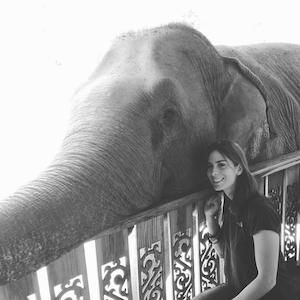
Jessica: Yeah! Another example is with another elephant organisation I'm working with, Voices for Asian Elephants Society. Where elephants are used, as I mentioned, in temples and similar places. Instead of saying "don't use them that way," they've been using robotic elephants so they can use those instead of real elephants. So you're still honouring the culture, but you're not hurting an actual elephant. So it's in the same way: substitute, a different model than shaming or just trying to ban.
Camoya: I'd also think that probably makes the conservationist job easier and much more interesting.
Jessica: Definitely more nuanced.
What would it look like for you to live in a world or community that centres on care and eco justice for ecosystems, wildlife, and people?
Jessica: This was a really great question. And mulling over this, I think I came up with a couple of things. So one was, I was thinking about agency, and basically the ability to make choices about your life. So even though wildlife are very different from us, ultimately, what they want is what most humans want. You want to be able to make important choices about your life without the threat of violence, right? That's the basic sense of dignity and agency.
And so if I were imagining an ideal world, it would be for both humans and wildlife to have that ability. And that doesn't mean there will never be conflict, but when we're thinking about how we interact with people who are different from us, can we respect their agency and dignity? And I think that's really what I want. I want there to be a paradigm shift from viewing them merely as resources to viewing them as other nations, as I wrote in my paper. Maybe they have different customs than us. They have different communication strategies, which we don't know about. But that doesn't mean it's less valuable. You know, they have their ‘whale’ culture and their ‘elephant’ culture.
And if we're designing our world to, for example, build a highway, can we build a corridor for them so that we're respecting their pathways as well as our pathways? So that was one thing. The idea of agency.
The second thing is, I was thinking about individual well-being and community well-being, how they are interconnected, and how we need both. How can we preserve social customs and cultural customs while also valuing the needs of individuals, both human and non-human? So rather than seeing individual rights and collective rights as at odds, how could we integrate them? And I'm not fully a philosopher, so I don't know, but ideally, it's finding a way to be in a community that values individuals while also respecting the community.
With conservation, I think about that in terms of we want to protect ecosystems, we want to protect species, but I don't want to do that at the expense of having individual animals suffering. And I want to protect cultural traditions, TCM and wildlife in festivals, but I don't want to do that at the expense of animal suffering. So that, I think, is the crux of my vision for that.
Camoya: I love that you talked about the different cultural worlds for different species, because I think that's so important. And sometimes, as humans, I think it would do us well to just think about the lessons that we can learn from them and their social practices and ways of being on this earth. Because some of it is so cool and inspiring, and because of the resilience that other species have on this planet, I think humans completely take it for granted.
And a lot of the messaging in conservation is animals being threatened and animals in endangerment and going extinct, and it's all of these really big, very intense things that we have to have a conversation about, totally. But I think, on the flip side, there are animals that are adapting and changing in real time. And I think that is the nice thing about being human and creating all of this: maybe it also means we can learn the lessons we need to learn.
Jessica: I think resilience is a great way of thinking about it. And I think that's helpful for humans, too, when thinking about what the alternative is to basically doomscrolling about conservation, politics, or anything. It's resilience, right? And okay, what can I change and what hope do I have? And that's a necessary condition.
And for animals, when you give them a chance, many recover very quickly. You even look at places like Chernobyl or something and see that animals have rewilded it. I mean, nature's ability to rewild and adapt is really amazing. And so I think it's important to be aware of threats and to take it seriously, but you also have to have, I think, the attitude of resilience and hope. Otherwise, it's like, why are we doing this? It's all still worth fighting for.
Learn more about Dr Rizzolo and her thoughts on wildlife tourism, curious new areas of conservation research, and the role of creativity during these politically tumultuous times in part two of this interview, published Monday, February 23rd, 2026.
Follow @WildWeStand on Instagram and LinkedIn for more conversations.


Comments