
Reimagining Conservation and Creativity with Dr Jessica Bell Rizzolo: Linking Policy, Wonder, and Ethics for Animal Welfare - Part Two

Camoya Evans continues interviewing Dr Jessica Bell Rizzolo, an interdisciplinary researcher whose work spans wildlife tourism, wildlife trade, and conservation policy. Moving from activism to academia, Dr Rizzolo emphasises the agency and social lives of animals and calls for new conservation frameworks that restore ecosystems and animal agency. She explores the complexities of captivity and wildlife tourism, highlighting the need for animal welfare literacy and transparent, community-led approaches. Dr Rizzolo also addresses challenges in wildlife trafficking, the nuances of Traditional Chinese Medicine, and the ripple effects of species substitution. She envisions a future where creativity, collaboration, and awe drive a restorative, eco-just world for humans and wildlife alike.
Given today's political landscape, how do you view the power of policy to spark social change? What other creative strategies might succeed in the face of increasing authoritarianism?
Jessica: This was a really thoughtful question. I thought about this a lot over the last couple of days. And I think, for me, policy and social change are a feedback loop. Policy can increase social change by forcing new conditions. I've seen that with the ivory ban in China, a government saying “enough” has caused some consumer change. But I also think it's a feedback loop in which policy sometimes reflects social change. The impetus for that policy is usually people saying social norms have changed or evolved, and we want that reflected in the policy, which then further increases social change. So I do think policy still has a role.
But I've also been thinking about the role of science and writing as creativity and awe. I recently saw that, after Trump defunded something, the people who had been working on it ended up putting together a book of their own poetry about the natural world. It's called The Nature of Our Times, I think, or something like that. And I think of science as creativity, it's a way of thinking about the world in new ways, right? That's what discovery is. I think we protect things, ecosystems, cultures, and animals that we have some awe, love, and reverence for. So I don't see science as dry data; I see it as a way to tell stories, which I do in my other work too.
I think right now, people, in particular, with the fatigue of the news cycle and all this, need a sense of wonder and awe. And you can get overly fatigued of bad news, bad news, bad news. How can we ignite wonder and awe? That's what I see in science and other creative pursuits. And it's been interesting to see how people have tried to find ways of combining those. I'm in a group called Writing the Wild, and it's full of people who care about the environment and are also writers who blend those concerns towards advocacy for the wild, so creativity in various forms is what we need.
Camoya: Absolutely. Finding ways to constantly allow people to connect is the way forward. I think science gives me a ton of gratitude for this earth because it shows you, and if you observe it, you can understand how it works. It's a way of communicating with everything here. It's just impossible not to have any sort of gratitude for what this planet does for us and for all the living beings on it.
Jessica: Gratitude is a great word, awe and gratitude. That's how I feel when I read science. I was reading about a spider the other day. And you know, insects, I don't know. That's not really my area. There's a spider that creates a fake spider in its web to deter predators, and it's this beautiful work of art. How amazing is that? We think a spider is just small, but it's beautiful and ingenious. My mind is still evolving in terms of my awe for animals, so I really want to share that with others as well.
What resonated with you about Wild We Stand and the collective, and do you see the intersection between our mission statement and your journey to doing this work and your continued research work now?
Jessica: So the first was how conservation is a bit of an outdated term, and that you favour the idea of restoration because there's constant change. Restoration in the sense of almost thinking about past harms, and how we can try to find ways of moving past those and restoring ecosystems. And I think a lot about that. I think I use the term "conservation," but it is a bit problematic, and only because I also think we need a new framework for it. For me, I think about it as I've been in the animal welfare, animal well-being, animal rights, and conservation worlds. And sometimes they don't talk to each other, and sometimes the conservation world is very focused on genetic integrity or populations. And then you end up with practices like culling that really harm the animal social fabric. And so, I wrote a paper about this a while back called Wildlife Self-Determination and the idea of agency. How can we restore agency to wild populations?
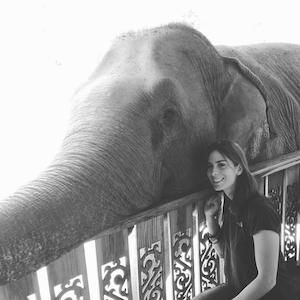
So that was one area. And then you also had a piece about working with people very close to the issue, on the ground. And that made me think of some of the work I do that's very important, and specifically with elephants, because it's such a complicated issue with captive elephants. I completed one project with the Mahout Elephant Foundation in Thailand, and they work with communities to bring elephants back from tourist camps. And they think of conservation being an interconnected web of the forest, protecting the forest, protecting the community, and protecting the elephants, and that has worked a lot better than some models coming in and saying, okay, now you have to do this, this, this. So that model of thinking I've seen resonated really well with your mission statement.
Camoya: I appreciate you mentioning that there probably should be a new framework used within conservation. Because I agree, I also use the word conservation, knowing it is a problematic word, as you say, but what other word do we use? What word describes the folks working on this movement and its work? So it's so hard to know what that word is without it being ‘conservation’. So I run into that trouble all the time. Wild We Stand is a conservation collective, but we're not super fond of that word either.
Jessica: Be reflective on it, which you are. We can use that word, but just reflect on what we mean by it, and how we're maybe thinking about that word differently. Another organisation I thought of is Wildlife for All, and they’re talking about wildlife management in the US and how it's often designed just for people with a consumptive view of wildlife. And how can we make that more reflective of the range of values that people have about wildlife? And so they use that term, but they also try to distance it a little from the traditional model of hunting and fishing, almost as if there are diverse ways of interacting with and valuing animals. And so I feel this is a part of other people's conversations as well.
With wildlife tourism on the rise, and that being an area of your research, how do you view the argument that captivity helps both animals and conservation? This is a topic I've seen come up in multiple spaces regarding tourism and its pros, so I would be curious to hear your thoughts.
Jessica: So, I think about the different forms of captivity and what the purpose of the captivity is. So captivity refers to any animal being kept in human dominion. But that could be for various reasons. So I think there's a big difference between animals being kept in captivity for rehabilitation, because they have no other option, or because they're being kept in captivity just for human needs.
So one thing I've thought a lot about in this area, with David Fennell, my co-author on many of these tourism pieces, is what we call animal welfare literacy. How can tourists go in and understand the difference between a legitimate sanctuary, for example, and a greenwashed sanctuary, where it's not actually a sanctuary? There are some main factors to consider. First, are the animals' needs being met in captivity? Are their needs being met in a way that doesn't leave them overly confined or lacking food, water, etc.? Then, is it for rehabilitation? For example, the Sheldrick Trust in Kenya has elephants in captivity, but they are being rehabilitated for release back into the wild. And you can still visit there as a tourist if you donate to the organisation. But the purpose is rehabilitation, not breeding them in captivity to endure it for generations.
Do the animals have a choice about whether they're close to humans? So I think one thing about wildlife tourism is that if an animal comes close to you and that's its choice, that's okay. But are the animals being forced into proximity with humans they don't want to be near? For example, posing with tigers. In Asia, where you posed with tigers, they are drugged because tigers are unlikely to approach a human and be fine with it.
I think captivity can help wildlife when it's for legitimate rehabilitation or conservation breeding purposes, but that's very different from some of the other greenwashing that occurs. In terms of the justice for animals piece, if tourists develop animal welfare literacy, can they recognise that an elephant shaking isn't dancing but is in psychological distress?
Trip promoters and sites like Expedia or TripAdvisor play an important role in helping us avoid the worst of the worst and curate experiences so people have a realistic expectation of what is actually happening. Because it's hard when you see something online. Sometimes tourists book something, get there, and are like, "Oh, this isn't very good." But it can be greenwashed on the website, too. And that's where I think website operators could play a role in curating it more effectively.
Camoya: That would be a great corporate accountability [exercise], to just try to keep things as transparent as possible. Is there a lot of policy around wildlife tourism? What governance does that fall under?
Jessica: There are different [ways], usually it comes in the form of accreditation. There are different organisations that will say, you have this seal or that seal. If you look at animal organisations like World Animal Protection, which has done a lot on wildlife tourism, they usually provide an overview of which ones are good and which ones aren't. They've been the ones that do a lot of investigations into some of the worst facilities and all that.
On top of that, governments sometimes just want to promote tourism and might not be motivated to limit it. It really depends on the country. Looking at environmental and animal protection organisations, I see they have different accreditations and guides that I think are helpful. They're people who come in with the idea that the animals' needs come first; they're not here to promote tourism.
I recently saw that you've left your position at the US Fish and Wildlife Service. And I'm curious, are there new areas of
Conservation research, are you interested in, or are there other topics of this work that you think are a bit under-researched?
Jessica: So that's very new. I'm still thinking through that, but I think a lot of these areas that I'm already working on, what I'm hoping to do now, that I have a little bit more freedom of speech and movement, is to reach out to some of these collaborators again and see what they're working on and see what I'm interested in. Find collaborations there and let them evolve organically.
But I think the ongoing areas, as I mentioned, are within wildlife trafficking. There's live animal trafficking that I think needs more attention, because those animals still have a chance to be rehabilitated. So, how can we think about the unique issues with live animal trafficking? And that's one thing I'm working on right now with elephants. I'm working on forming a working group on that. Another would be integrating animal well-being and welfare into conservation. How can we find models of conservation, used broadly, that acknowledge individual animals and their social structures and things like that?
TCM is another area I really want to work on more. I would love to, now that much of this work was done during Zika, COVID, and other pandemics, do more on-the-ground collaboration with some of my collaborators there. Because TCM can get very tricky, too, with different species. So, with big cats, for example, tiger, lion, or jaguar bone is sometimes used, which creates a ripple effect on other species. And I think that's an area that we're interested in looking more at, how does demand for one species ripple into similar species and substitutes? Because a substitute isn't necessarily sustainable, right? You could substitute tiger bone with lion. There's been lion farming in South Africa for that reason, speaking of wildlife farming.
And then, just on a personal level, I would say, as I mentioned, the idea of creativity, advocating for wildlife, and just finding new ways to do that through creative work and writing. And there's a lot of interest and energy in the creative community of artists and writers, and how can we pool our resources as creative people in different ways? And that's very new. I'm just trying to explore that. But as my life goes on, I feel that's something I really want to explore more. Rather than reinventing the wheel, we often talk about social change or social policy. I think scientists are at the forefront of discovery, but you often see artists, writers, and other creative people at the forefront of social change as well. So those collaborations, I think, could be really interesting. That's just an area I'm exploring, but I hope it will lead to something more tangible. I'm not quite sure how it will manifest yet, but I'm trying to lay the foundation.
If you enjoyed this conversation, we would love to hear from you! Drop a comment or reach out.
Follow @WildWeStand on Instagram and LinkedIn for more conversations.


Comments